Top 5 Automated Parcel Sortation Trends (2026)

Quick Answer: The UK warehouse automation market is forecast to grow from $2.4 billion in 2025 to $5.6 billion by 2034. The five trends behind that growth — AMRs, real-time data capture, modular parcel sortation systems, guided picking, and energy-efficient automation — are already operational across UK fulfilment centres, not still in pilot phase.
The five trends below — Autonomous Mobile Robots (AMR), Real-Time Data Capture, Modular Parcel Sortation Systems, Guided Picking, and Energy-Efficient Automation — aren't pilot projects. They're running at operational scale inside UK distribution centres right now, and the operators using them are pulling ahead of those still evaluating.
This isn't a forecast. It's a status report.
Trend 1: Autonomous Mobile Robots (AMRs)
AMRs have moved past the proof-of-concept stage. UK fulfilment sites are now running fleets of them as standard infrastructure, not showcase projects. Industry benchmarking puts the average UK fulfilment warehouse at around 4.25 robots in 2025, a figure expected to climb to 7.52 robots per site by 2030.
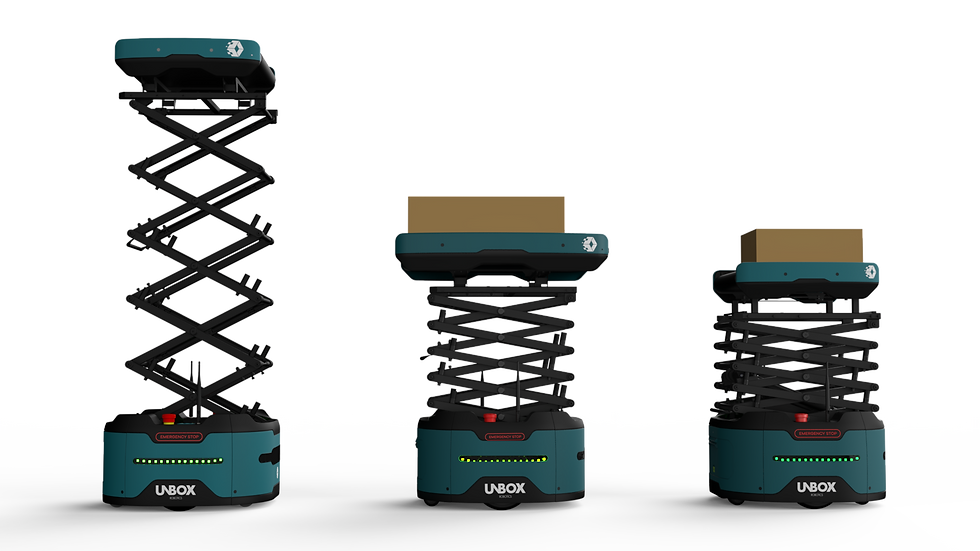
The UK warehouse robotics segment specifically generated roughly $242 million in revenue in 2023 and is projected to reach $804 million by 2030 — a compound annual growth rate of 18.7%, among the fastest of any UK logistics technology category.
The labour context makes this urgent rather than optional. According to Logistics UK's 2026 Employment and Skills Report, the sector's challenge has shifted from a raw shortage of workers to a deeper skills gap — with 61.6% of HGV drivers and 47.7% of warehouse managers now aged 45 or over.
Separately, the UK Warehousing Association's 2025 Skills Survey found that only 13% of warehousing employers report no difficulty recruiting staff, and over half expect critical skills shortages in automation and robotics within five years.
For UK operations, the AMR business case isn't primarily about squeezing out extra efficiency anymore — it's about covering shifts and tasks that would otherwise go unstaffed. That's why automated parcel sorting and robotic transport are increasingly framed as workforce continuity tools rather than pure cost-cutting measures.
AMRs are no longer a capital risk. In a market with a widening skills gap, they're a staffing strategy.
Over half of UK warehousing employers expect a critical skills shortage in automation and robotics within five years. See how AMRs close that gap in your operation.
Trend 2: Real-Time Data Capture at Every Touchpoint
Manual data entry at goods-in was already a bottleneck. In 2026, it's a competitive liability.
The shift toward automated data capture — dimensioning and weighing at inbound, scan tunnels at sortation, camera verification at packing — produces something manual processes can't: a clean, continuous data trail from dock to dispatch.

This matters beyond accuracy. Real-time data is what makes every other trend on this list function. AMRs need live inventory signals to route correctly. A parcel sorting system needs accurate item data to divert parcels correctly the first time. Warehouse management platforms need verified inbound data to generate reliable pick assignments. The whole automation stack depends on data quality at the source.
The stakes are rising because UK online retail isn't slowing down. The ONS internet-sales ratio — the share of total UK retail sold online — has held near 28.1% through early 2026, one of the highest shares of any developed economy. At that volume, delayed or disconnected inventory data doesn't just cause the odd mis-pick; it compounds into shrink, wasted labour, and missed delivery promises at scale.
DWS (dimension, weigh, scan) systems at inbound and scan tunnels at outbound aren't isolated hardware purchases anymore. They're the data infrastructure layer that every other automation decision in the building depends on.
Every automation decision downstream depends on clean data at the source. Find out where your dock-to-dispatch data trail is breaking.
Trend 3: Scalable Modular Conveyor and Sorting Systems
Fixed conveyor infrastructure has served UK logistics for decades — and it's also been the source of one of the industry's most persistent headaches: the inability to reconfigure without a costly rebuild.
The global parcel sortation systems market is valued at roughly $3.14 billion in 2026 and is forecast to reach $4.19 billion by 2031, growing at a 5.97% CAGR, driven by e-commerce scale-up, same-day delivery pressure, and AI-assisted sorter controls. Within that, tilt-tray systems are the fastest-growing segment — projected at a 7.68% CAGR through 2031 — prized for their small footprint in space-constrained urban depots, a layout constraint that applies directly to UK sites operating inside tight city-edge distribution parks.
Scalable, modular conveyor and sortation systems are making automated parcel handling more accessible to a wider range of logistics operators. Unlike traditional large-scale installations, modular systems can be deployed incrementally, allowing businesses to expand capacity as parcel volumes grow while minimising disruption and upfront capital investment. This flexibility has made modular automation an increasingly attractive option for operators looking to improve throughput without committing to a complete facility overhaul.
The trend extends beyond major distribution hubs. In the UK, Guernsey Post recently invested £1.8 million in an automated parcel sorting system at its Envoy House headquarters to reduce manual handling, increase processing efficiency, and support growing parcel volumes—demonstrating that modular sortation is becoming a practical solution for regional postal operators as well as large logistics providers.
The operational case is straightforward: when volume profiles shift — seasonally, contractually, or because you've won new business — a modular automated parcel sortation setup adapts with you. You're reconfiguring, not rebuilding.
A sortation system that can't grow with your operation isn't an asset — it's a constraint with an expiry date. Compare modular options before your next volume shift.
Trend 4: Pick-to-Light and Voice-Directed Picking Reducing Error Rates
Manual picking accuracy plateaus no matter how experienced your team is. Paper lists and RF scanning typically produce error rates in the 3–5% range under normal conditions, climbing further under peak-season pressure.
Pick-to-light systems can lift productivity by 30–50%, with accuracy consistently above 99%, and they're particularly well suited to high-volume, small-item order profiles — exactly the mix most UK e-commerce fulfilment centres handle.

Training time drops just as sharply: new operators can often reach reliable accuracy in as little as four hours, versus days for manual methods, with no measurable accuracy gap versus fully trained staff.
Voice-directed picking extends the same gains further with hands-free, eyes-free operation — particularly effective in cold-store or high-SKU environments where visual concentration is already stretched.
Why this matters specifically for UK operators right now: returns. UK non-food online returns are forecast at roughly 19.5% for 2025, and UK clothing return rates now average 23.6% of ecommerce orders.
Under the UK's Consumer Contracts Regulations, that's up to 42 days of cash tied up between order and refund on every returned item. Picking errors are a direct driver of returns volume. For operations under margin pressure from reverse logistics costs, tightening pick accuracy through automated parcel sorting and guided-picking technology is one of the few levers that reduces returns at the source rather than just processing them faster once they're back.
Trend 5: Sustainability Pressures Driving Energy-Efficient Automation
ESG reporting is no longer just a compliance exercise for UK logistics operators — it's becoming a commercial gatekeeper, with brands and retailers increasingly requiring sustainability commitments before they'll sign fulfilment contracts.
The UK is legally committed to reaching net zero by 2050, and government figures show UK greenhouse gas emissions already down 63% since 1990. Energy efficiency has become a bottom-line priority as much as an environmental one.
Depending on the facility and level of automation, UK warehouses typically consume around 50–70 kWh of electricity per square metre each year. In many ambient warehouses, lighting represents one of the largest electricity loads, making LED retrofits a high-impact upgrade that significantly reduces electricity consumption between 65%-95%.
The encouraging part is that energy efficiency and throughput efficiency are increasingly aligned rather than in tension. Systems that run lean — automated sorters that activate only when load justifies it, AMRs routed on optimised paths, conveyor sections that power down during inactivity — deliver both a lower carbon footprint and a lower cost-per-parcel.
For UK operations building 2026 and 2027 automation roadmaps, energy consumption per parcel now belongs on the specification sheet alongside throughput and accuracy. Vendors who can't answer questions about power draw per cycle, or who have no integration path with on-site energy monitoring, are falling behind where UK procurement is heading.
Energy consumption per parcel now belongs on the spec sheet alongside throughput and accuracy.
What This Means for Your Operation
These five trends aren't independent — they compound.
An AMR fleet performs better fed by clean, real-time data from inbound DWS systems. Modular parcel sortation systems integrate cleanly with pick-to-light zones. Energy-efficient automation across the stack lowers total operating costs in ways that show up directly in the ROI model.
The UK operations winning in this environment aren't necessarily the ones with the biggest automation budgets — they're the ones sequencing connected decisions about which touch points to automate first, building toward a system where every node generates data and every piece of equipment earns its place.
Persistent labour shortages, a long-term shortage of industrial and logistics space, and continued e-commerce growth are accelerating investment in warehouse automation. Operations that sequence their automated parcel sortation investments strategically in 2026 will be better positioned to handle rising demand in 2027 and beyond.
People Also Ask: Automated Parcel Sortation
What are the fastest-growing areas of automated parcel sortation in the UK in 2026?
Autonomous Mobile Robots (AMRs) are among the fastest-growing areas of warehouse automation in the UK because they can be deployed quickly, scaled as demand grows, and integrated without major infrastructure changes. Their flexibility makes them an attractive choice for warehouses seeking to automate material movement while avoiding the cost and disruption associated with fixed automation systems. Reflecting this broader trend, industry forecasts estimate that the average UK fulfilment warehouse will operate approximately 4.25 robots by 2025, rising to 7.52 robots by 2030, highlighting the accelerating adoption of robotics across warehouse operations.
How does real-time data capture improve UK warehouse performance?
Real-time data capture — through DWS systems, scan tunnels, and camera-based verification — closes the gap between what physically happens in a warehouse and what the warehouse management system records. This improves pick accuracy, reduces inventory discrepancies, and gives every downstream automated parcel sortation system reliable inputs to work from.
Are modular parcel sortation systems cost-effective for mid-sized UK operations?
Yes. Modular parcel sortation systems typically require less upfront investment than large, fixed conveyor installations and can be expanded incrementally as parcel volumes increase. Their flexible design allows operators to add capacity over time, making them a cost-effective option for mid-sized UK businesses looking to automate without committing to a full-scale infrastructure overhaul.
How long does it take to train operators on pick-to-light systems?
Most UK operations report training times of around four hours — significantly faster than RF scanning or paper-based picking methods — with no meaningful drop in accuracy during the shorter ramp-up period. Read this case study on pick-to-light effeciency.
Is sustainability a real factor in UK automation procurement decisions?
Yes. Sustainability is becoming an increasingly important consideration in warehouse automation procurement as businesses seek to reduce operating costs, improve energy efficiency, and support their environmental commitments. The UK's legally binding net zero target, together with growing customer and investor expectations, is encouraging many operators to evaluate the energy efficiency and long-term environmental performance of automation systems alongside traditional measures such as throughput, reliability, and total cost of ownership.
Don't Just Automate—Optimise throughput with Emerdis
From pick-to-light to high-speed parcel sortation, the future of fulfillment relies on connected data. Emerdis bridges the gap between your physical assets and digital intelligence. Our robust WCS seamlessly integrates AMR robotics and real-time DWS capture into a single, high-performing ecosystem.
The content on this website is for general informational purposes only and does not constitute formal engineering, financial, or professional advice. Figures, case studies, and metrics are illustrative estimates based on specific projects; actual results will vary depending on your unique infrastructure and operational variables. Emerdis accepts no liability for any loss or damage arising from reliance on this information. For advice tailored to your specific facility, please contact sales@emerdis.com for a formal assessment.


