7 Reasons Your DWS System Needs a Pallet Dimensioner

A pallet dimensioning system is an automated component of your DWS system that captures the length, width, height, weight, and barcode of palletised freight in under 3 seconds — eliminating the manual measurement errors that trigger carrier reclassifications, inflate freight charges, and erode margin on every outbound shipment. Warehouses integrating pallet dimensioners into their DWS systems report processing time reductions from 3 minutes to under 30 seconds per pallet, with documented savings of up to $100K annually on freight billing corrections.
Most warehouses invest in a DWS system for parcel-level accuracy — and then leave pallet measurement entirely to a tape measure and an operator's best guess. That's where the margin disappears.

Pallets are your highest-volume, highest-risk freight category. They're bulky, irregular, and frequently measured wrong. The result?
❌ Carrier disputes
❌ Reclassification penalties
❌ Missed damage claims you can't prove.
And a finance team asking why your freight bill keeps climbing.
A pallet dimensioner is the upgrade your DWS system is already built to accept.
Here's exactly what it fixes — and why the operations teams not using one are quietly subsidising their carriers.
What Is a Pallet Dimensioning System?
A pallet dimensioning system is an automated measurement device — typically mounted at ceiling height at your loading or unloading dock — that uses 3D cameras or computer vision to capture the precise dimensions, weight, barcode data, and photographic proof of palletised freight in 2–3 seconds per scan.

It feeds that data directly into your WMS, ERP, or DWS system, eliminating manual data entry and creating a verified digital record of every pallet that moves through your facility.
When integrated with a full DWS system, it closes the measurement gap between your parcel-level accuracy and your freight-level reality.
7 Reasons Your DWS System Needs a Pallet Dimensioner
Manual Measurement Is Your Single Biggest Source of Billing Errors
Operators measuring pallets with a tape measure routinely miss protrusions, uneven stack heights, and overhanging loads. The result is understated dimensions submitted to carriers — which triggers reclassifications, correction charges, and billing disputes that take weeks to resolve.
A pallet dimensioner captures to within 1 cm height accuracy and 2 cm length/width accuracy, automatically, every time.
Carrier Disputes Don't Resolve Themselves — But Photographic Proof Does
Without a verified dimensional record at point of despatch, you have no evidence base for a dispute. Carriers know this.
Pallet dimensioners capture timestamped freight photographs alongside dimensional data at the moment of measurement. When a carrier raises a reclassification or a dispute lands on your desk, you have a verifiable record — date, dimensions, weight, image — that your DWS system logs automatically.

You're Losing Loadable Cubic Space on Every Trailer
Inaccurate pallet dimensions mean inaccurate load planning. When your system records a pallet as larger than it actually is, you're booking trailer space you're not using — and paying for it.
Pallet dimensioners give your load planning team exact cubic data per pallet. Feed that into your WMS and you stop leaving profitable space on the trailer floor. The same principle drives your DWS system at the parcel level. Your pallets deserve the same precision.

Reclassification Penalties Are Silently Eroding Your Margin
Every time a carrier remeasures a pallet and finds a discrepancy against your submitted data, you pay a reclassification penalty. For high-volume 3PL operations and e-commerce fulfilment centres processing dozens of pallets per shift, these penalties compound rapidly.
A pallet dimensioner integrated with your DWS system eliminates the discrepancy at source. The data submitted to the carrier matches what arrives — because it was captured by the same automated measurement infrastructure, not estimated at the dock.
Processing Time Per Pallet Drops From Minutes to Seconds
Manual pallet measurement — tape measure, manual data entry, checking against the carrier rate card — typically takes 3 minutes per pallet. At 30 pallets per shift, that's 90 minutes of operator time that produces nothing except a number that may still be wrong.
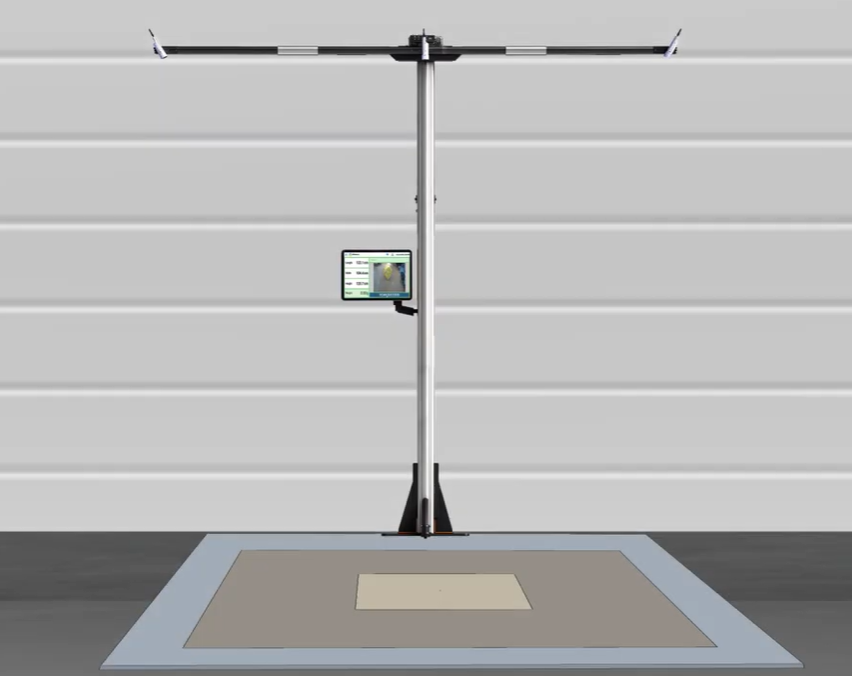
Pallet dimensioners complete the full measurement cycle — dimensions, weight, barcode, image — in under 2 seconds. That's throughput your operation gets back on the same shift, without adding headcount.
Seasonal Volume Spikes Don't Have to Break Your Measurement Accuracy
Peak season is when manual measurement errors accelerate fastest. Operators are under time pressure. Pallets are moving faster. Shortcuts get taken.
A pallet dimensioner integrated with your DWS system is immune to this.
Measurement accuracy doesn't degrade under volume. The system captures at line speed regardless of whether you're processing 10 pallets per hour or 100. Your freight data stays clean precisely when the cost of errors is highest.
This is why the operations teams scaling into high-volume retail contracts — the 3PLs proving throughput to prospective clients — are integrating pallet dimensioners now, not after the next peak.
Your DWS System Data Is Only as Complete as Its Pallet Coverage
A DWS system that measures every parcel but estimates every pallet is operating at partial accuracy. Your freight billing, carrier rate compliance, and shipping cost reporting are built on a data set with a systematic gap in it.
Pallet dimensioners close that gap. Every shipment — parcel or pallet — enters your DWS system with verified, automated dimensional data. Your reporting is complete. Your finance team can reconcile it. Your carriers can't dispute it.
That's what a fully integrated DWS system actually looks like.
What to Look for in a Pallet Dimensioner for Your DWS System
Not all pallet dimensioners are built for the same operational environment. Before specifying a system, confirm these five criteria:
How Pallet Dimensioners Fit Into a Complete DWS System
A full Dimensioning, Weighing, and Scanning (DWS) system handles every measurement touchpoint across your warehouse — from inbound SKU capture at goods-in, through pick-face accuracy, to outbound freight verification at despatch.
Pallet dimensioners are the outbound freight layer of that system. They don't replace your parcel DWS — they complete it.
The data flow works like this:
No manual input. No measurement variance. No billing surprise.
This is how Emerdis approaches DWS system deployments — not as isolated pieces of equipment, but as integrated measurement architecture across your full operation.
How Much Does a Pallet Dimensioner Cost?
A standard Pallet DWS will start from £15k with larger integrated enterprise-grade systems costing £90k+. All costs are approximate.
The ROI calculation is straightforward: at documented savings of up to $100K annually on freight billing corrections, most deployments recover their investment within the first year of operation.
Frequently Asked Questions
What does DWS stand for in warehouse logistics?
DWS stands for Dimensioning, Weighing, and Scanning — the three measurement functions that automated inbound and outbound freight processing systems perform simultaneously to capture accurate shipment data for billing, routing, and compliance.
Can a pallet dimensioner integrate with my existing WMS?
Yes. Modern pallet dimensioners connect via API to most major WMS, ERP, and shipping software platforms, transferring dimensional data automatically without manual input. Confirm native connector availability for your specific platform before specifying a system.
What is the difference between a parcel DWS system and a pallet dimensioner?
A parcel DWS system is optimised for individual packages and cartons — typically measured at goods-in or on conveyor lines. A pallet dimensioner is designed for palletised freight, handling larger and irregular loads at loading and unloading docks. Both feed into the same data infrastructure; together they provide complete measurement coverage across your operation.
How accurate does pallet measurement need to be for carrier compliance?
UK and EU carriers typically require dimensional accuracy within 1–2 cm to avoid reclassification. Manual tape measurement rarely achieves this consistently under operational pressure. Automated pallet dimensioners maintain sub-2 cm accuracy on every measurement regardless of throughput.
How long does a pallet dimensioner take to install?
There are three configurations available: Floor standing, Ceiling or Column mount. Installation typically requires a ceiling or column mount at dock height, plus integration with your WMS or ERP. Total installation time ranges to can take between 12 to 24 hours for a single-dock setup. For multi-dock or multi-site deployments take longer.
Eliminate the Measurement Gap in Your DWS System
Emerdis deploys integrated DWS systems across UK and EU warehouse, 3PL, and e-commerce fulfilment operations. If your pallet measurement process is still tape-and-estimate, we can show you exactly what the upgrade looks like — and what it costs your operation not to make it.
The content on this website is for general informational purposes only and does not constitute formal engineering, financial, or professional advice. Figures, case studies, and metrics are illustrative estimates based on specific projects; actual results will vary depending on your unique infrastructure and operational variables. Emerdis accepts no liability for any loss or damage arising from reliance on this information. For advice tailored to your specific facility, please contact sales@emerdis.com for a formal assessment.


